Case Study
Autonomous Line Following Robot with Real-Time Telemetry
An integrated approach to autonomous pathfinding, combining rapid prototyping, custom structural CAD, and an embedded IoT dashboard for rapid control loop tuning.
The Challenge
Developing a highly responsive autonomous system requires constant iteration. The traditional bottleneck in developing line-following robots is the PID tuning process: repeatedly tweaking variables, recompiling code, and reflashing the microcontroller wastes valuable testing time. The challenge was to engineer not just a mechanically sound, lightweight robot, but a seamless development ecosystem that allowed for instantaneous, on-the-fly control loop adjustments without interrupting the testing workflow.
Technical Deep Dive
Hardware Architecture & CAD
- Rapid Prototyping: Validated the ESP32 firmware and sensor logic early using a functional cardboard prototype, allowing parallel development of software and the final mechanical frame.
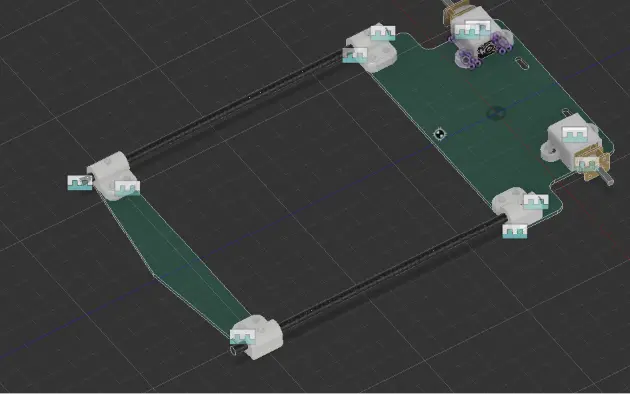
- Mechanical Design: Modeled a minimalist, lightweight chassis in Fusion 360. The design uses separated front (sensor) and rear (drive) plates bridged by rigid structural rods to drastically reduce overall mass.
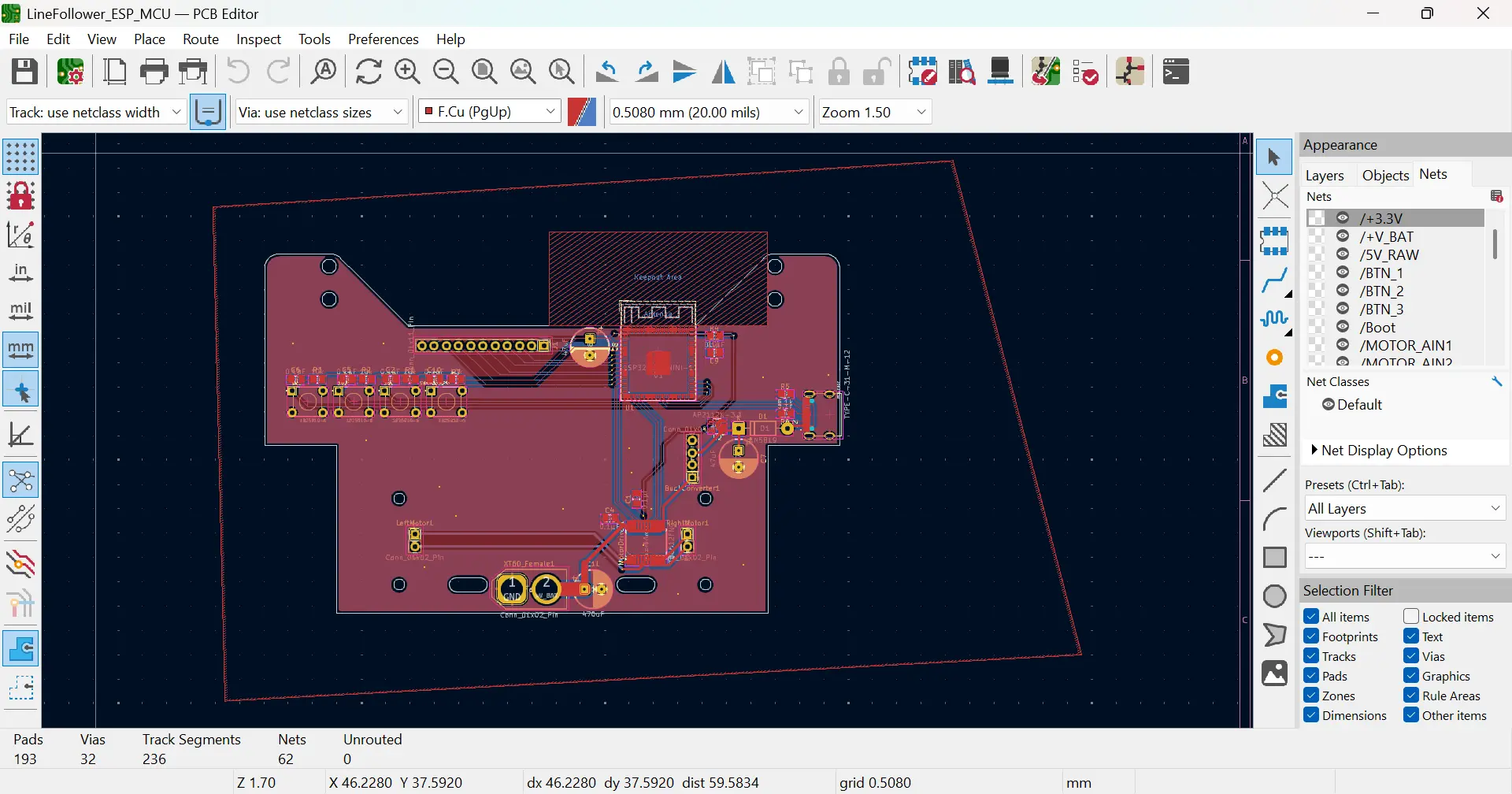
- Custom Integration: Leveraged the A1 Mini to 3D print custom motor brackets, rod clamps, and electronic mounts, ensuring precise alignment of the 8-channel IR array while maintaining structural rigidity.
Firmware & Control
- Algorithm Evolution: Iterated the firmware from a basic analog threshold system to a robust digital weighted-average error calculation, ensuring precise line tracking even at high speeds.
- Embedded Web Server: Hosted an asynchronous HTML dashboard directly on the ESP32 acting as an access point. This allowed any mobile device to connect and push parameter updates via HTTP GET requests.
- Real-Time Telemetry: Engineered a precision UI enabling instant synchronization of Proportional, Integral, and Derivative constants. Added hardware-level LED feedback to visually confirm successful parameter syncs during track tests.
Results
- Workflow Optimization: Eliminated firmware compilation time during track testing, reducing the PID tuning cycle from minutes to milliseconds.
- Dynamic Stability: The transition to a weighted error algorithm allowed the robot to remember the line’s last known position during track fly-offs, enabling aggressive self-correction.
- Validation & Testing: Successfully demonstrated autonomous line tracking on variable tracks, proving the viability of the web-based PID tuning workflow and the mechanical durability of the rod-bridge chassis.
Gallery & Models
Click any image to preview.