What a DGCA Licence Actually Unlocks: Field Repairs at an Army Base before Independence Day
Before August 15th — India’s 80th Independence Day — I was on the way to Bengaluru with two teammates, a toolkit, and an assignment I had not expected to be doing as a third-year undergraduate student.
We had been called to a base to diagnose and repair a large quadcopter that had previously been through a crash. Our job was to fix it, and validate the aircraft with test flights before the day was done.
I want to write about this clearly: this was not a structured internship or a college programme. It was an opportunity that arrived because of a combination of what we had built, what we had documented, and one specific credential that signalled we were ready to operate legally and responsibly on a platform of this size.
That credential was the DGCA Remote Pilot Certificate.
Read: I Got My DGCA RPAS Pilot Certificate. Here's What the Exam Doesn't Teach You. →
The Platform
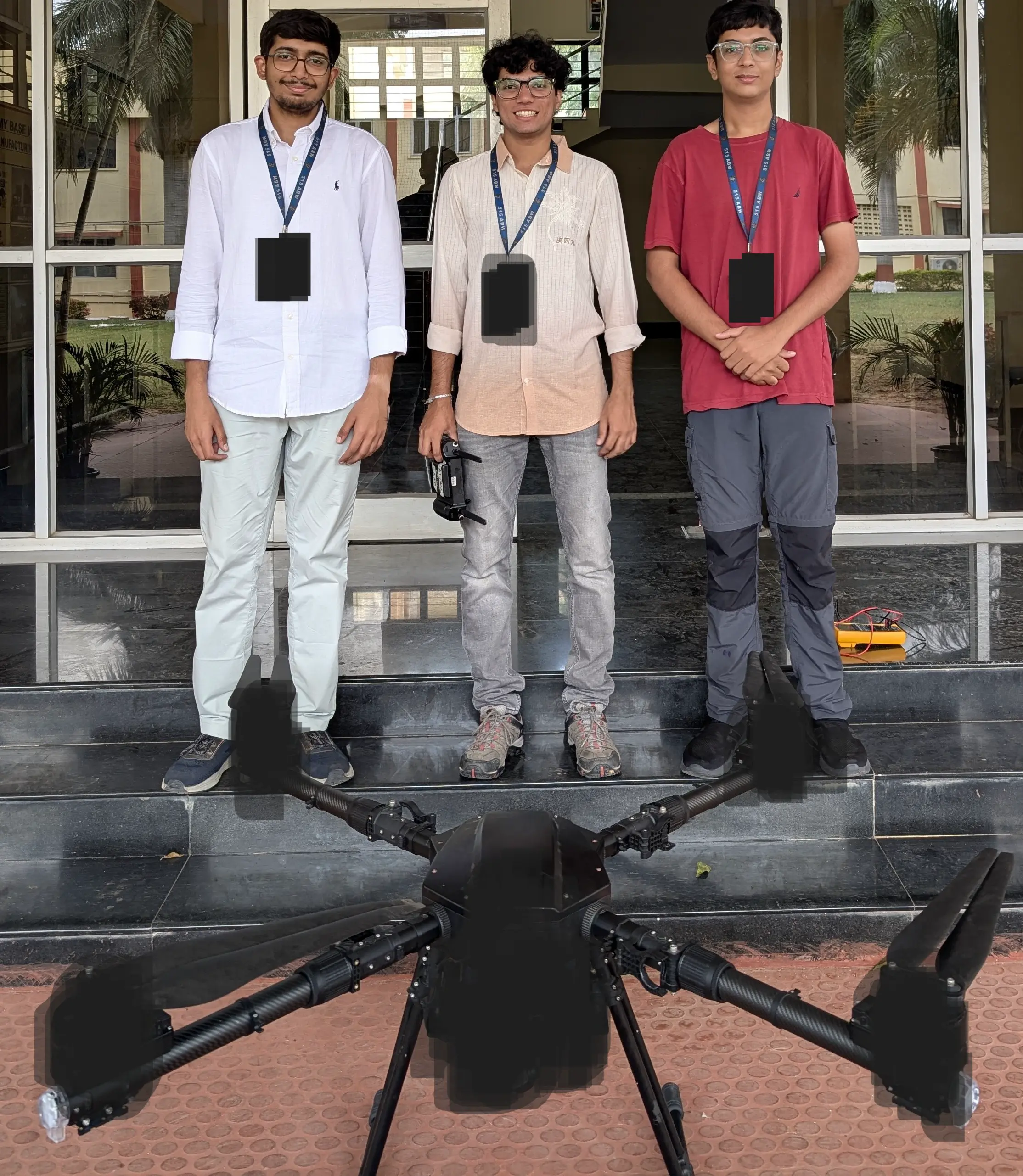
The platform we worked on — a large-format quadcopter running electric motors. Built to a standard you don’t see in commercial hobby builds.
The aircraft was a large-format quadcopter running heavy-lift electric motors — a class of propulsion hardware designed for heavy professional and industrial use. I am keeping platform-specific details vague intentionally. What I can say is that the machine was significantly larger and heavier than anything I had personally handled before, and the engineering standard it represented was immediately apparent when we started inspecting it.
Everything was enclosed. Every electrical connection was protected. Every component had been selected not just to meet the requirement but to exceed it with margin. This is something you do not fully appreciate until you are standing next to a machine built to defence standards after spending your engineering career in the world of hobby-grade and prototype hardware.
The Diagnosis
The drone had come down in a crash caused by a firmware issue. After the incident, one motor was confirmed dead — but nobody had been able to isolate which subsystem had failed or whether the motor itself was the only affected component.
We started at the motor. The electric motor uses a modular hub assembly, and our initial inspection pointed to the motor itself as the primary failure point rather than the ESC or the power distribution system. Confirming this required going through the electrical chain methodically: checking continuity on the phase wires, inspecting the ESC signal path, and ruling out upstream faults before committing to a component swap.
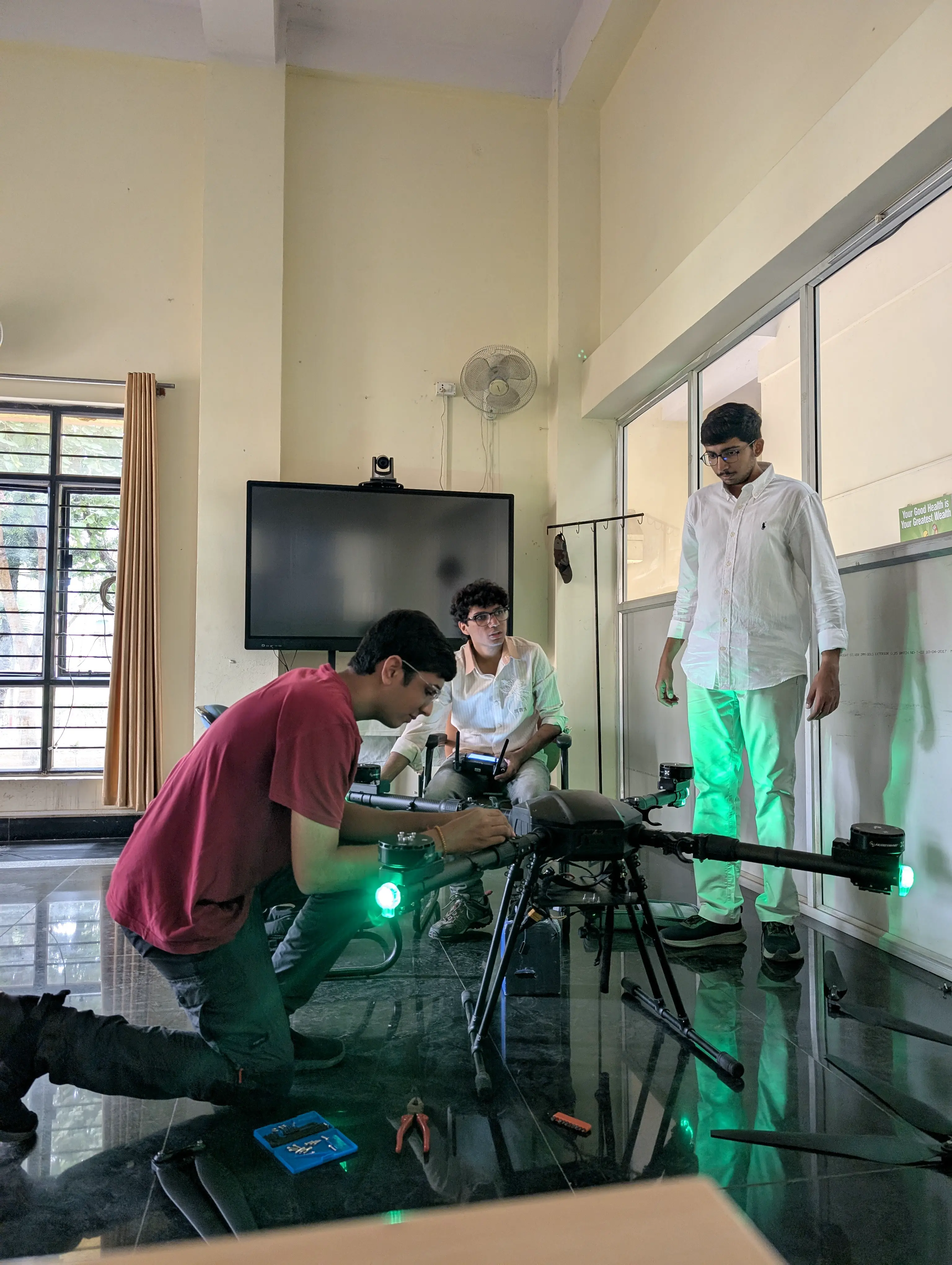
Working through the motor replacement — removing the hub assembly, splicing the signal cables, and soldering the new power connector before reassembly and airframe inspection.
Once the fault was confirmed, the repair sequence was:
- Full removal of the motor and its hub assembly from the arm
- Sourcing the replacement hub and motor from the spares on-site
- Soldering a new XT60 connector on the replacement unit and heat-shrinking the joint properly
- Splicing and re-routing the ESC signal cables to the new motor
- Full airframe inspection before reassembly — checking every arm, every mounting point, every connector for damage from the original crash that might not have been visually obvious
- Reassembly and pre-flight systems check
None of this is technically exotic. Anyone who has built and repaired quadcopters knows this workflow. What made it different was the scale, the weight, and the context. Moving a drone of this size through an inspection and repair sequence is physically demanding in a way that bench work on a hobby quad is not. Every step takes longer. Every component is heavier. The margin for error feels different when the aircraft is this size and the operational context is what it is.
The Calibration Problem
After the repair, the drone needed a full accelerometer calibration — a standard 6-point procedure that involves locking the aircraft into each orthogonal orientation and capturing the gravity reference at each face.
On a 680mm development quad, this is mildly annoying. On a large-format defence-grade platform of this weight, it is a genuine physical task. Two people needed to hold the aircraft stable in each orientation — the overhanging arms fight you, the weight works against you on every face that isn’t flat on the ground, and any movement during the capture window means doing it again.
We got through it. But standing there, manually holding this aircraft through six orientations and thinking about the mechanical repeatability issues with hand calibration, I understood — in a way I hadn’t before that moment — exactly why I had spent the previous weeks building an automated calibration rig.
Test Flights and Validation
With the repair complete and the calibration done, we conducted validation flights to confirm the aircraft was functioning correctly. The objectives were basic but non-negotiable: stable hover, controlled translation, response to control inputs, endurance and stability under sustained flight, and correct failsafe behaviour.
The aircraft flew. Every system performed as expected. The repaired motor ran cleanly. The validation was clean.
What Defence Engineering Looks Like Up Close
The most lasting thing from this trip was not the repair. It was the engineering standard.
In hobby and prototype drone work, you make component selections under constraints — budget, local availability, delivery time, what fits on the frame. You accept compromises because the alternative is not building at all. The defence-grade platform we worked on had been built with none of those constraints applying in the same way. Every component had been selected to survive harder conditions than it would realistically encounter. Every connection was protected against the kind of failure modes that a poorly-built hobby quad accepts as normal operational risk.
The electronics were fully enclosed and sealed. The power connections were clean and redundant. The structural design had margin built into it at every point. Nothing about the aircraft had been done the fast way because the fast way was good enough.
That standard is something to aim at. Not because every build needs to meet it, but because internalising what it looks like changes how you think about your own design decisions.
On Getting Opportunities You Are Not Expecting
I want to be direct about this because I think it is worth saying plainly.
This trip was not on any roadmap. It was not the outcome of a structured application process or a planned career step. It arrived because of a combination of accumulated work — the flight controller builds, the DGCA certification, the documented engineering — that made us credible candidates for a task that needed to be done.
The DGCA certificate specifically mattered. Not because it proved engineering competence — it does not, as I have written elsewhere — but because it proved that we understood how to operate a drone legally and responsibly at the size class of aircraft we were being asked to work on. Without it, the conversation might not have happened.
There is also something specific I want to say about doing something for the first time at a scale you have not worked at before. The honest experience of it is this: you do not feel fully ready. The aircraft is bigger than what you have handled. The context is more serious. The people around you have more experience. You are aware of all of this simultaneously.
And you do it anyway, because your skills are real even if they have not been exercised at this specific scale before. The diagnostic methodology does not change because the drone is heavier. The soldering technique does not change because the setting is unfamiliar. The calibration procedure is the same procedure regardless of how much the aircraft weighs. What you have built in the lab and the workshop transfers — not perfectly, not without adjustment, but it transfers.
Have confidence in what you know. Execute carefully. Ask when you are not certain. That is sufficient.
On Discipline, Respect, and Wanting to Contribute
Meeting the officers at the base was a different kind of education entirely. The discipline, the precision, the absolute clarity of purpose — these are things you observe and carry with you.
I came home wanting to be better at my work. Not in the abstract sense of wanting to improve, but in the specific sense of wanting the things I build to be of genuine use — to be reliable, to be well-engineered, to meet a real need. The armed forces of this country operate systems that are the difference between mission success and something worse. The people who build those systems have a responsibility that I understood more clearly after spending a day in that environment.
I do not know exactly what form my contribution will take. I am a third-year student with a flight controller stack, a calibration rig, and a DGCA certificate. That is not much by the standards of the engineers who build these systems professionally. But it is a foundation, and it is pointing in a direction I care about.
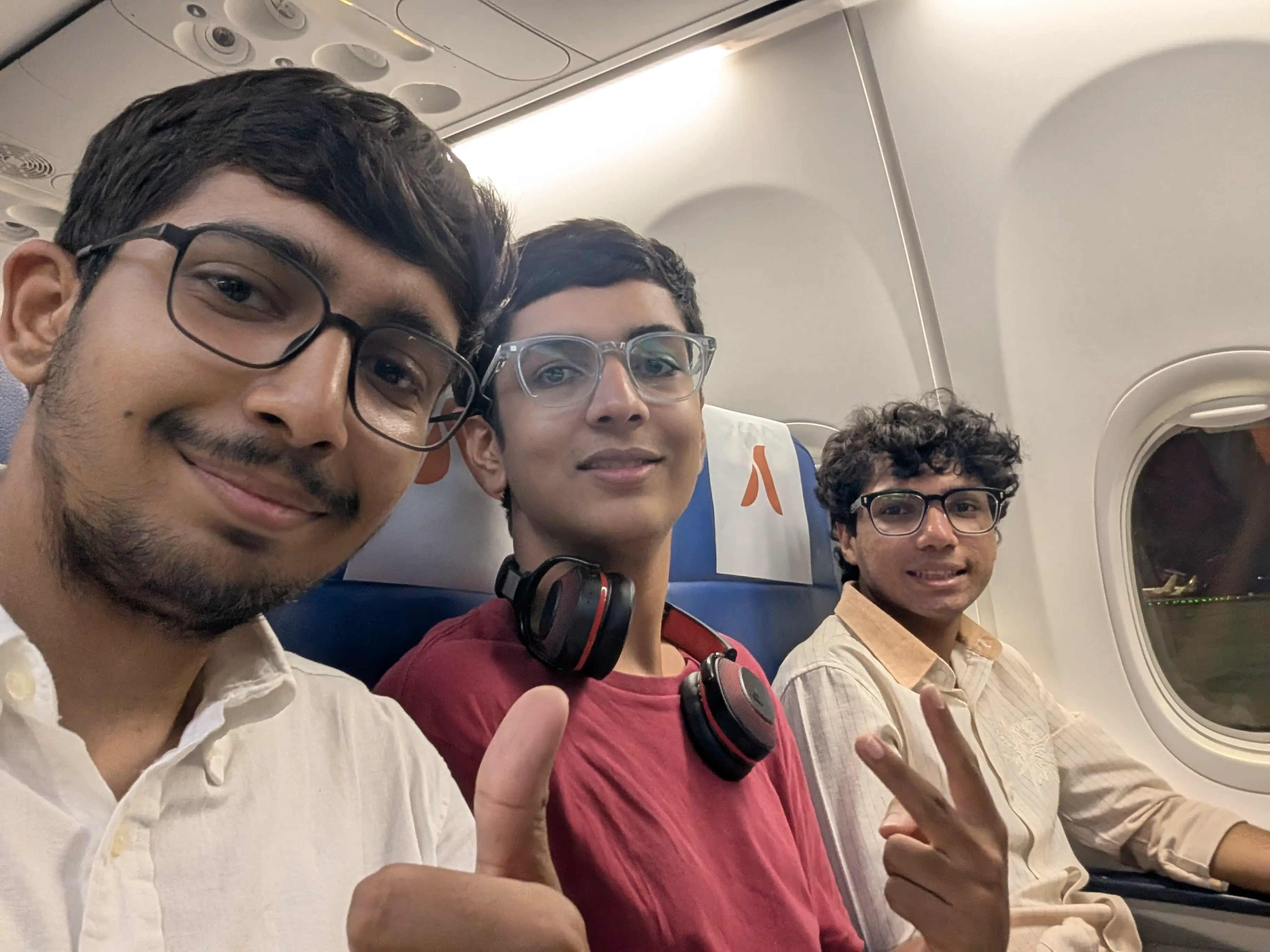
On the way back. Dhyan Patel (main pilot), Adidev Shah (co-pilot and engineer), and myself. The kind of trip you remember.
Jai Hind.
The automated 6-axis IMU calibration rig referenced in this post — built to solve exactly the kind of manual calibration problem we encountered on this trip — is documented in the projects section. The DGCA Remote Pilot Certificate post is linked above.